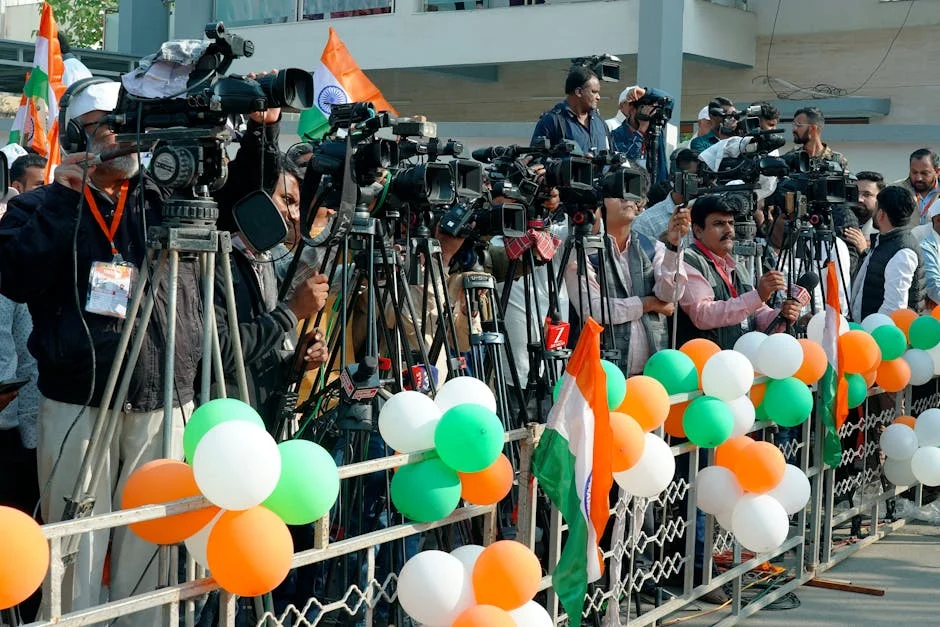
Indian Prime Minister Narendra Modi faced immediate diplomatic friction after a pointed question from Norwegian journalist Helle Lyng during a recent press briefing. The exchange has triggered a wave of online backlash and sparked fresh concerns among international investors regarding the stability of India’s political branding. Markets in Singapore and London are watching closely to see if this diplomatic spats translates into tangible economic volatility.
Diplomatic Friction Meets Market Sensitivity
The incident occurred during a high-stakes media interaction where Lyng challenged the Prime Minister on specific policy directions. Modi’s response was perceived by many observers as abrupt, leading to a rapid escalation of sentiment on social media platforms. For investors, such moments are no longer just political curiosities; they are indicators of governance style and foreign policy consistency.

India’s economy is currently the fastest-growing among major economies, with GDP growth projected at approximately 6.5% for the current fiscal year. This growth attracts billions in foreign direct investment, particularly from technology and manufacturing sectors. However, political capital is a fragile asset. When the leader’s image is challenged, even by a single foreign journalist, it can ripple through the confidence of institutional investors who rely on predictability.
Traders in Mumbai and Delhi are already monitoring the Nifty 50 index for signs of nervousness. While the immediate impact may be subtle, the cumulative effect of diplomatic inconsistencies can erode the "India discount" that has favored the rupee against the dollar. Singaporean investors, who hold significant stakes in Indian IT firms, are particularly attuned to these nuances.
The Role of Media in Shaping Economic Perception
Helle Lyng’s question was not merely a journalistic probe; it was a test of the government’s narrative control. In an era where news travels at the speed of light, the perception of strength or weakness can shift market sentiment within hours. The backlash on platforms like X (formerly Twitter) amplified the incident, turning a five-minute exchange into a global talking point.
For businesses operating in India, the media environment is a critical component of the risk assessment model. A hostile or unpredictable media landscape can signal broader regulatory uncertainties. Companies planning to expand in regions like Karnataka or Maharashtra must consider how political optics influence consumer sentiment and government favor.
The incident highlights the growing interdependence between political diplomacy and economic performance. Investors are no longer looking solely at balance sheets; they are analyzing the political capital of leaders. Modi’s handling of the question serves as a case study in how personal diplomacy can intersect with national economic interests.
Impact on Foreign Direct Investment Flows
Foreign direct investment (FDI) into India has seen a steady uptick, driven by the "China Plus One" strategy adopted by global manufacturers. However, these investments are sensitive to political stability. Any perception of diplomatic rigidity or unpredictability can cause hesitation among multinational corporations. Companies like Apple and Tesla are closely monitoring the political climate in New Delhi.
The backlash against Modi’s response may not immediately halt investment flows, but it adds a layer of caution. Investors prefer leaders who project confidence and clarity in international forums. The incident serves as a reminder that diplomatic soft power is as crucial as hard economic data in attracting capital. Singapore, as a major hub for Asian investments, is well-positioned to gauge these shifts.
Social Media as a Market Barometer
The speed of the online backlash demonstrates the power of social media in shaping economic narratives. Within hours of the press briefing, hashtags related to Modi and Lyng trended globally. This rapid dissemination of information allows markets to react before official statements are even released. Algorithmic traders often pick up on sentiment shifts detected through social media analysis.
For the average investor in Singapore or London, this means that political news can have immediate financial consequences. The volatility in Indian equity markets can affect global portfolio performance. Hedge funds are increasingly using natural language processing tools to analyze political speeches and media interactions for early signals of market movement.
The incident also underscores the importance of digital diplomacy. Governments are now competing for attention in a crowded digital landscape. A misstep in a press conference can lead to weeks of narrative management, distracting from core economic policies. This distraction can have tangible costs in terms of policy implementation speed and clarity.
Implications for Singaporean Investors
Singaporean investors have a substantial presence in the Indian market, with many listed companies in the Singapore Exchange (SGX) holding significant exposure to Indian growth. The political dynamics in New Delhi directly influence the earnings forecasts of these companies. A stable political environment is essential for sustained profitability.
The backlash against Modi’s response may prompt some investors to reassess their risk exposure. While the long-term outlook for India remains positive, short-term volatility can be managed through diversification. Singaporean financial analysts are advising clients to monitor political developments alongside economic indicators. This holistic approach helps in making more informed investment decisions.
Furthermore, Singapore serves as a neutral ground for many international business negotiations. The diplomatic incident may influence how Indian companies engage with their Singaporean counterparts. Trust and reputation are critical in these relationships, and any erosion of confidence can have lasting effects on trade and investment flows.
Long-Term Economic Consequences
While the immediate reaction was one of outrage, the long-term economic consequences will depend on how the Indian government manages the aftermath. If the incident is seen as an isolated event, markets may quickly return to their previous trajectory. However, if it signals a broader pattern of diplomatic friction, it could lead to a more sustained period of uncertainty.
Investors are looking for signs of policy continuity. The Indian government’s ability to maintain its economic reforms agenda amidst political noise will be a key determinant of market confidence. The success of initiatives like the Production-Linked Incentive (PLI) scheme will depend on a stable political environment. Any distraction from these core policies could slow down the momentum of India’s economic rise.
The incident also raises questions about the role of the media in holding leaders accountable. While transparency is essential, the manner in which questions are posed and answered can have significant implications. For businesses, understanding these dynamics is crucial for navigating the complex landscape of Indian politics and economics.
What to Watch Next
Investors should monitor the next few weeks for any official statements from the Indian Ministry of External Affairs regarding the incident. The government’s response will provide clues about its approach to foreign media and diplomatic relations. Additionally, watching the performance of key Indian stocks listed on the SGX will offer insights into market sentiment.
The upcoming quarterly earnings reports from major Indian IT firms will also be critical. These reports will reveal whether the political noise has translated into tangible business impacts. Investors should pay close attention to management commentary on geopolitical risks and their mitigation strategies. The intersection of politics and economics continues to be a vital area of focus for global investors.
See Also
- IEA Releases 400 Million Barrels of Oil as Middle East Conflict Shakes Global Markets
- India's Public Sector Banks Brace for War Escalation — Economic Impact Looms
Singaporean financial analysts are advising clients to monitor political developments alongside economic indicators. The upcoming quarterly earnings reports from major Indian IT firms will also be critical.